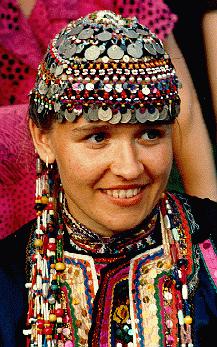
The Finno-Ugric people are the original inhabitants of the European and
Eurasian north that belong to a separate "Uralic Family" linguistic group. The
Finno-Ugric substratum is present over a wide area within and outside Russia, from Norway to the Urals and down to the Black Sea.
Mari People Under Attack by Russians 2005. - Appeal for Help
In these pages, the term "race" is not used to describe groups of people because it is merely a construct and does not exist in reality. There is no race of Finns,
Russians, or even Englishmen. Besides, the term is not useful in most cases
because everyone living today is of more or less mixed genetic content. The idea
of a "master race" or "superior race" has been thoroughly disproved. Racism is a term derived from the concept of "race." But it is really just hatred and violence against anyone different from oneself or of what they consider a lower grade stock, by someone who imagines belonging to some elite or higher group as for example royalty. Race theory presupposes that at one time there existed separate races, which in time started to mix, and there is no proof of that - quite the opposite. According to anthropologists we all came from Africa. Further, the total spectrum of humans, whether traits be based on color or any other criteria, is impossible to separate into categories. What will be the catergories? Who will decide? A person would end up in different groups depending on what criteria was used. Attempts to broaden the concept of race to "white", "black", "yellow", "brown" or whatever is filled with similar problems. What shades are "white" and could you have siblings belonging to different "races?" Therefore categories of "race" really have no place in good science at all, in the opinion of the writer. It is a concept which blurrs science. Besides, the main difference between all people for our purposes is cultural and linguistic, and the rest are subjects for feature character analyses of people. These can be categorized statistically, but cannot be sorted into "races" as such.
Newcommers filtered in to Finland over millennia and were absorbed by other arctic, possibly related people. The writer does not believe that the Finnish people "arrived" there from somewhere else, filling a vaccum. They had already been moving East and West for millennia on their ancient water-ways. The choice to settle in any area, including the present day Karelia and Finland was made for various reasons relating to survival in the north. The Finland we are talking about is not the present political boundary area, for their wilderness trips covered a much wider area and involved trade through various middle-men. The term Finn shall refer to Finnic people, covering the area between Norway and the Volga and North to the White Sea. Immigrants to these northern wilderness hunting, trapping and fishing grounds were from many different places, but over time they mixed and created the Finnish people. From this perspective, Finnish, like Saami, is an indigenous language of the north independent of genetics.
Mari People Under Attack by Russians 2005 - Sign protest sheet.
As the ice retreated about 10,000 years ago, stone-age men, perhaps early
Finns, occupied the rich new lands between Norway and the Urals. They were
followed by other wanderers in the North, many of which were Germanic. According
to Matti Klinge, (University of Helsinki), the dominant "genetic element" in
Finland today is Germanic.
Perhaps Germanic people had also followed game northward since the dawn of
history and were accepted there amongst the Finns. When the waves of disease
swept over Europe, it is possible that the germanic genetic traits (ie. the ones
carrying specific immune factors, such as blood type A), survived because the
immune factors were already there and did not have to be produced by the human
immune response. In this way, beneficial traits were gradually imported along
with technology to the North from Europe.
The eastern Finnic nations
mixed with wanderers from the south and east and therefore they
differ genetically from the western Finns. This genetic variability was beneficial to the
eastern Finns as well. Biological diversity is what helps species to survive, and this applied to the Finns as well. Naturally, in different geographical areas gene pools differ due to "genetic drift," which is a very well understood phenomenon. The Volga Finnic people are referred to as Finns here even though they differ
significantly in many ways, especially in the language which is mostly
conversationally unintelligible to Baltic Finns.
Chapter 1: The Volga Finns: The Mari
People
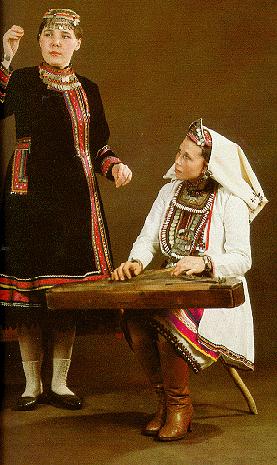
Mari Kusle, "Kantele" in Finnish - traditional musical
instrument.
Listen to Finnish
Kantele Music
- English:
- Proto-Finno-Ugric:
- Finnish:
- Mari:
|
- One two three
four five
six seven eight
- Ykte kakte kom- neljä-
vit(t)e kut(t)e
- Yksi kaksi kolme neljä
viisi kuusi seitsemän
kahdeksan
- ikte koktit kumit nilit
vizit kudit shimit kandashe
|
- Counting in Uralic Languages
The Mari People
(by Vassili Nikolajev translated from Finnish by Osmo
Joronen)
The Mari people are a middle Volga ancient Finno-Ugric nation.
- The Mari's divergence from the rest of the western Finno-Ugric speakers
began about 3000 years ago. By 500 AD, the Mari nation had become established
from the ancient Mari inhabitants of the Volga and also from the newly arrived
Iranian cattle herding tribes. The meadow and mountain Maris differentiated from
the original volga residents by 1000 AD. The name Cheremis (Sarmys) was probably
a Turkish related Tšuvas name for the Mari, which was then adopted by the
Turkish-Mongolian related Tatars, and Slavs. The Slavs propagated the term
Cheremis, which others adopted as well. The word Mari, by which the Mari call
themselves, may be derived from the Iranian neighbours. Apparently, the Mari
used to live further west, where the Oka flows into the Volga. Historical
accounts, place names and folk tales confirm this.
The Mari have been closely associated with the Tšuvas people from
ancient times, as evidenced by the numerous loan words which are in all the Mari
dialects. The Bulgars, who were the forefathers of the Tšuvas, settled in the
middle Volga area in the 700's. The Mari were incorporated into the Bulgar's
economic and administrative influence. Then, when the Mongolian-Tatars invaded
the Bulgar state in 1230 AD, the Bulgars moved north up the Volga into the Mari
territory and settled there. After that there came the golden horde that took
over Kazan, and their rule, and finally the Russian rule starting in the
1500's.
Statistics of Mari People
In 1989 the population of Maris was 670 000 persons, of which 80.8 %
claimed the Mari language as their mother tongue. About half (324 000) of the
Mari people live in Mari El in the bend of the Volga River. There are Maris also
living in Bashkir (106 000) Kirov province (60 000), Sverdlovsk, Perm (30 000),
Tataria, Udmurtia, and so on.
Based on cultural differences, the Mari are divided into three groups:
Mountain, Meadow and Eastern Mari.
Linguistically Meadow and Eastern Maris together form the Eastern
Mari dialect and Mountain Mari is called the Western Mari dialect,
which includes the dialects of Mari residing in Vetluga River regions. The
relative composition of Mari people are: Mountain Mari 10%, Meadow Mari, 60% and
Eastern Mari 30%. They have their own literary language, but most use the
Eastern Mari literary language (85-90%), namely the native speakers in Mari El
Republic's East half, those residing on the North shore of the Volga (Meadow
Mari), those in Baškortostan and Tatarstan, Udmurtia, Perm and Sverdlovsk
provinces. The Western Mari dialect is spoken by 10-15% of Mari people ie. those
on the South bank of the Volga and some Mari in Nishni-Novgorod and Kirov
provinces.
The closer contacts between the Mari and Slavs began in the beginning
of the 1400's. At this time, the Mari joined with the Tatars against the
encroaching Slavs.
- However some Mari joined the Russian forces. The Mari who lived on the
south side of the Volga sent representatives to Moscow, and explained that they
would like to join the the Slavs against the Tatar rule. But the Meadow Mari on
the north bank remained united with the Tatars. This split the Mari in two, and
in 1553, Moscow's armies under Ivan The Terrible conquered Kazan. The Mari
continued their fight against the invading Russians under their own leadership.
These merciless wars were known as the Cheremisian Wars, which lasted from
1553-1580, and resulted in the extermination of one-half of the Mari nation.
Malmy was the last stronghold of the Mari. This was distroyed in
1556. The Mari holiday held on April 26 remembers the fallen heros of this war
and honors their great leader Poldšin.
The 1500's also marked the beginning of the Orthodox Church's forced
conversion of the Mari people. Those who did not accept the new religion were
persecuted and taxed heavily. Most of the Mari people chose to flee East to
excape the new government. Over the next several hundred years, they became
known as Eastern Mari people, and this group, which numbers around 200,000,
still constitutes the major part of the Maris that live outside the Mari
Republic.
During the Tatar rule, the Cheremises were divided into three
classes: those who paid taxes, tax-free army reserves, land-owners and leaders.
During the Russian rule, these divisions were preserved in the beginning. But
towards the end of the 1700's, to own land, you had to be baptized. The tax-free
status of the army reserves was ended in 1718 and they were combined in with the
peasant classes who were now expected to serve in the army. The Mountain
Cheremises ended up as serfs.
During the 1700's during the Elizabethan era many Mari people
converted to the Orthodox faith, after which they were released from their tax
burden. But the old nature-worship still survived beside the new religion,
however, their taxes were huge. Russification with the help of the general
school system began in the early 1800's but they were unsuccessful. These
efforts were renewed in the 1900's and the results are most evident in the
Western Mari.
Mari Educational System is born
- The year 1775 was an important year. This year saw the beginnings of Mari
literature; it was the beginning of teaching the Mari language. It was tied to
the Cyrillic alphabet. The New Testament was translated in simplified form into
the Western Mari language in 1821. During the 1800s the Orthodox Church ran
the schools, where the Mari language was taught as well. The Mountain Mari
school readers appeared in the year 1867, Meadow Mari school readers came out in
1870.
Four books of the Bible were translated into Mari in 1906. By the
September Revolution, there were already 225 books written in the Mari language.
Most of them were for use by the Church and its schools. 1905 was the birth of
Mari literature. That year a Mari poem appeared in the Mari language written by
Sergei Šavain called "Oto"(leaf tree forest). The first secular works,
the Marla Kalendar (Mari Yearbook) appeared between 1907-13.
These literary works were the beginnings of Mari literature. The
Biblical translations were the model for correct grammar. After the 1917
revolution Maris began developing a proper grammar in its full meaning with
renewed energy.
The Mari Autonomous Republic was established in 1920. Mari and
Russian languages were declared "official" languages in 1923. Officials had to
know both languages, and education was in both languages all the way to high
school. The 1920s was the golden age of Mari culture.
In 1936 the Mari Autonomic Socialist Republic was established. The
development begun earlier did not continue far. In 1937 the educated class of
Mari El was almost totally destroyed by Stalin's decree. A mass grave of 200
Mari writers was found in a swamp near Joskar-Ola, and on Stalin's orders, the
educated class was desimated: artists, skilled workers, doctors, and teachers,
together about 4000 - in other words the cream of Mari El. The murdered people
of 1937 were reburied in a communal grave near Joskar-Ola in 1990. The bodies
were recovered from their mass graves with all the bodies in disarray with vodka
bottles and other liquor bottles. Every skull had a bullet hole. Dispite the
terrible fate of the Mari people at the hands of the Communists, the Mari
culture could not be destroyed. Fortunately Mari literature made a comeback
after WW2. The period after Stalin's death (1953) was called Krushchev's
Protective Era. In 1960 Mari literature was reborn. Valentin Kolumb
(1935-1974) was the best known writer of this period. Kolumb dealt with the Mari
condition in a time when the subject was not appreciated by the Communist
government.
In a short time Kolumb wrote ten books which have been translated
into other languages, but not into Finnish. The themes are current events, but
the poems contain a lot of thoughful and timeless philosophical themes. Kolumb
is the renewer of Mari poetry (meter); as the first Mari lyricist he used a free
(vapaata riimillistä mittaa in Finnish) verse. Kolumb also translated
some Kalevala runes as well as Shakespeare, Goethe, Petöf and other world
classics. In 1963 Erik Sapajev wrote the first Mari opera "Akpatyr" based on the
text by Sergej Tšavain. Akpatyr tells of the wars between the Mari and Tatars.
The main character Akpatyr is based on a Mari mythological character.
- But, at the same time Khrushchev's educational renewal policies were a
disaster to the Mari educational system. The schools were Russified en masse
except for country schools grades 1-3 (1-4).
In villages with a majority of Russian speakers, the lower grades too
were soon taught in Russian. This was called the period of stagnation. It
was a time when youth felt that being a Mari was not an asset and many were
ashamed of their nationality. Many young Mari wished that their passports were
stamped "Russian." In literature, those who bent to the will of the
Communist Regime, produced "Mari Realism" - superficiality in which the harsh
life in the Communist state was smoothed out and repressed.
Geography and Statistics
Today Mari El is not a much bigger piece of the Volga shore than Mikkeli
province in Finland. Its area is 23 300 km2. Mariland is a part of the Russian
Federation. The population in 1993 was 760 000. The breakdown was as follows:
Mari 43% and Russians 47%, Tatars 6%, Tšuvash 1,3% etc. Mariland has altogether
50 nationalities.
- Opportunities to develop their own language culture have improved for the
Mari's as well as their brethren Finno-Ugric peoples. This is partly due to the
fact that in their name-sake Republic, there is a 43% Mari population and even
in the nearby Bashkortostan the Mari culture has survived comparatively well.
This compares with the lower Mordovia 34%, Udmurtia 31%, and Syrians in Komi
only 25%.
The capital city of Mari El is Joškar-Ola and it means "red city."
Joškar has another meaning in the Mari language, "beautiful." The capital city
has 300 000 inhabitants of which only a quarter (23%) is ethnic Mari, which is
not a lot relative to the Republic's population. On 22 October 1990 Mari
Autonomous Soviet Socialist Republic became a part of the Russian Federation.
Since 1992 the country is officially a Republic named Mari El. "Mariland" or in
Finnish, "Marinmaa," has its own parliament, national flag, crest and anthem.
Mari El is represented in the upper house (in Finnish korkeimmassa
neuvostossa) of the Russian parliament. In December 1991, the Republic of
Mari El got its first president. The first president was a mountain Mari
Vladislav Zotin. The Mari started to demand language and cultural rights similar
to other minorities in Russia. The increased freedom of speech which was present
after 1985 did not immediately have any impact on the literary output of the
little nation. Stereotypical thought and decades of brainwashing regarding
cultural history and identity were still alive and well.
The first literary works that showed any new ideology began to appear
in the late 1980s when the Stalin era archives were opened. The new Mari
literature is completely new and original and modernizing in style. They deal
with the terrible fate of the intelligencia during the 1930s, the stagnation
period and contemporary problems.
In April of 1990 the Mari Society (Marij ušem) was established.
Almost every area where there are Mari, you will find a chapter. In April of
1992 the democratic society of Marij ušem held its second congress. At this time
the basically social/cultural organization became a political party and a Mari
nation leadership meeting was called. The meeting was held 30-31 October 1992.
This was the third meeting of the Mari national movement. The first
two leadership meetings were held in 1917 and 1918, after which they were banned
for 75 years. Many important first steps were made in the direction of
developing a stronger Mari identity and protecting and developing the Mari
language and culture. In 1991 the Mari historical society established a
religious organization (in Finnish according to Vasli: "Valkoinen
luontouskovainen marilainen" ristimätön, puhdas, varsinainen marilainen). This
means that the ideal Mari believes in nature religion and is "not baptized, and
clean." When V. Zotin was elected as President, in 1992, an Orthodox minister
was called from Kazan to bless him into his position, since Zotin is Orthodox.
The Meadow Mari also demanded their "Kart" which is a nature worship priest.
(niinpä Os mari - simari johtaja siunaisi presidentin)
The Mari Parliament (Kugyzanyš Pogyn) was established in December
1993. There were 30 members. In 1994 there were 14 Maris in the Parliament and
the representatives are voted in by a free vote. By tradition, the Mari cultural
affairs, information, education and foreign affairs, during Zotin's time were in
the control of a Mari native speaker, and the Russians controlled industry,
environment and finances.1
But now the second president is Russian (Vjatšeslav Kislicyn)
who does not understand Mari, and the ministerial portfolios too have changed.
The country has about 20 political parties. Communists have continuing strong
support. 2 The presidential elections only
strengthened the Communist party. The classroom is usually represented by many
nationalities. The common language is Russian, the language of the majority.
Only in the countryside are there schools teaching lower grades in
Mari, and not in every village. According to the official sources, the teaching
in all Mari lower grades (1-3) and children's daycare etc. is in the Mari
language. But official and reality are two different things in Mari El, like
everywhere in Russia, as it was before in Soviet society, where what is
expedient and politically correct (for the Russians ofcourse) still rule. There
are still no schools in the Mari language in the cities so that when they
inevitably enter the cities, they are Russified against their will. 3
In the Fall of 1994 a new educational system appeared in Mari El,
which promised to increase the Mari culture in the schools. According to the new
system, in the lower grades, (grades 1-4) education would be in the Mari
language. Mari language, literature, history and culture would be offered in
most Middle Schools ( grades 5-11), Trade Schools, Technical Schools, and High
Schools. The problem is, there is so little written material in the Mari
language, and what exists is mostly out of date.
Since the 1993 Finnish Parliament's approval of support for
Finno-Ugric development, there has been an increase in the development of
teaching aids. According to official sources, there were 256 schools in Mari El
in 1989, where Mari language courses were taught, or was the language of
instruction. In 1994 there were 354. Despite this, Mari language and culture are
still being taught as a "foreign language and culture," only part-time and only
about 1-4 hours per week.
Outside of Mari El there are 250 schools in which the Mari language
and culture are taught. The text books are brought from Mari El, which itself is
short of teaching materials. 4
In 1994, only 1.3% of Russians spoke Mari. 5 In 1993, a National Secondary School (In Finnish,
"Kansallinen lukiokoulu") was established in Joskar-Ola. The Mari National
Secondary School: In 1994, interest in Mari language education both at the High
School and Technical School level was four times greater than available courses
to train teachers. In the Joskar-Ola Pedagogical Institute there has been
established additional groups, 25 for Mari students who will be training as
kindergarten teachers in the cities. Finnish and Estonian are taught in several
Mari schools as well. Interest in the Finnish language is great - the goal is
the strengthening the Mari identity with the help of the western related
languages. The Joškar-ola teacher's college (Fin=Joškar-Ola Opetusinstituutti)
offers Finnish on a regular basis. Finnish is also taught at the Joskar-ola
University's Mari Language Institute. Mari cultural life is somewhat impeded by
the fact that Joškar-Ola is over 75% Russian speaking, and therefore the course
offerings are correspondingly larger in the Russian language. 6
So in the Mari National Library is located in Joškar-Ola and it is
named after the great writer Sergej Tšavajn, who is like the counterpart
of Alexis Kivi, the great Finnish writer. The library was established in 1920.
Most of the books are printed in Mari El and concern the Mari people, the Mari
nation, its living conditions, nature, culture and history. Only 10% of the
books are in the Mari language. There are also foreign literature.
According to the Mari cultural sociologist (Marilaisen
kansantieteilijä) Timofej Jevsejev (1887-1937) his namesake National
Museum was founded in 1920. The National Museum has three sections: describing
Mari nature, culture and Mari tradition. The museum also displays articles made
by Mari living outside the Mari El Republic. In 1986 the museum had an
exposition of Finnish culture by IIdiko Lehtinen and sponsored by Finn-Stor. The
Mari National theater in Joškar-Ola, Sketan Theatre, was established in 1919. It
puts on programming 3-4 times per week in the Mari language. There is something
new every month - seven different Mari presentations per year plus some
translations. The director of the National Theatre is Vasili Pektejev who has
visited Finland many times as a director and actor, representing Mari Usem, and
taking part in the Tampere Summer Theatre program. The youth theatre, Samyryk
Teatr (Nuorisooteatteri) is called Irkabajev's Theatre, for its director. The
director, Oleg Irkabajev, is trying to renew the Mari Theatre's fame - with Mari
historical as well as modernistic presentations. It works out of its cramped
Joškar-Ola doll theatre as a room theatre. Irkabajev's theatre has received the
approval of the open-minded, educated Mari youth.
Joškar-Ola's doll
theatre, which is a relatively modern building, puts on doll shows in Mari and
Russian. In the Fall of 1992, Joškar-Ola doll theatre put on a show during
Finland's 75th anniversary celebrations, in the Mari language and Russian "Alvar
and Shadow" which was arranged by Miklai Rybakov and the Finnish director Nena
Stenius. The Mountain Mari's capital of Tsykmaan (Kosmodemyansk) has a new West
Mari dialect theatre as well. Joškar-Ola also has opera and ballet, but in the
Russian language.
There are many publications in the Mari language, but with small
distribution. Still they have an important meaning to Mari language, Mari
literature, native culture and the national identity. The publications are read
by Mari living outside the Republic as well. All the Mari publications suffer
from shortages of paper. There are just too few computers, or they do not exist
at all. The largest Mari language newspaper "Mari El." A very popular paper is
the illustrated humor publication called Patšemys. The Meadow Mari cultural
publication Ontsko (Forward) is about Mari literature and translations from
froreign languages. The comparable Mountain Mari publication is U sem (Uusi
sävel in Finnish) or New Tune. Of the children's publications, Ketše (Aurinko)
"Sun" is the most popular. A somewhat less popular one that appears in both Mari
dialects is the children's publication Jamde li in Eastern Mari, Jämde li in
Western Mari, or Be Prepared.
Kugarnja (Friday) is directed at 15 - 35 age group, which tries to
emulate the free style of Western publications. Kugarnja is noticeably freer and
more democratic than Mari El. The Mari publication distribution is as follows:
Patšemyš, Mari El, Ontšyko, Kugarnja, Ketše, Jamde li, U sem, Jämde li TV and
radio Mari language programs.
The majority of television and radio is in the Russian language. Every
day Mari television has 2-3 hours of programs where half is in Mari and the
other half in Russian. Joškar-Ola radio has 18.5 hours of programs which is
split 50-50 between Mari and Russian. Included in the Mari programming is also
some Western Mari dialect programs. The Mountain Mari, in Tsykma (Kosmodemyansk)
have their own radio station.
(Vassili Nikolajev, 1997 - an ethnic Mari) Vasli's Finno-Ugric
Magazine
-
- 1 Russian financial management is at third world level.
- 2 The Estonian Institute says
Communists cannot ensure the survival of Finno/Ugric
people.
- 3 Communism destroys native cultures:
the state takes over education of children. It happened with
the native people of Canada and the United States.
- 4 Why not help the Mari develop Mari
culture. Aid to Russia does not get to minorities.
- 5 This is typical of Russians, who
resist learning the language of whatever country they make their
home in, such as Karelia, Estonia, Latvia and Lithuania; Mari El.
- 6 Notwithstanding the fact that such a
large percent of Russian speakers live in Mari El, this should not
be too great a problem if the children in the countryside continue to get a
Mari education, and the numbers of Mari schools increase in the
cities. The same happened in Finland with the Swedes when they
outnumbered the Finns in the cities. This changed when the Finns
began moving into the cities. Perhaps founding a Mari Language
University in Mari El would encourage Mari from outside the Republic to
move there and change the demographics in favor of the ethnic
Mari.
MOSCOW ETHNOLOGIST BACKS LATINIZATION IN TATARSTAN - (RFE/RL Newsline Sept 4, 2001)
Valerii Tishkov, the director of the Moscow Institute of Ethnology, said that Moscow should back the introduction of the Latin script in Tatarstan because that will help anchor the central Volga republic into Europe and reduce the influence of the Muslim East, "Zvezda Povolzhya" reported on 30 August. PG
Latinization would also help anchor the Mari Republic to its cousins in Europe, namely Finland and Estonia. It would help to preserve the Mari culture and language by reducing the influence of Russian, which should be, and rightly so, a secondary language in the Mari Republic. Mari scholars could convert the existing texts and manuscripts in a reasonable length of time. And while they are at it, they could translate other languages to print. Finland may even be willing to finance such a project if the Mari themselves request it. Finnish could become a model for words previously borrowed from Russian. This may sound like a far-fetched idea but it could be doable.
-
-
Uralic and Finno-Ugric Links
- Dictionary-
Dictionaries of Uralic languages
- Maps- Uralic
Family Home Page map collection - Ancient place names: It should be underscored here that the scholars of prehistory and history regard ancient place-names of a country as proof of the identity of the language in which it occurs and that of their speakers who gave them to the places which they occupied and inhabited for a considerable length of time.
- FU Discussion - Some interesting stuff
- Komi hunting ethics - How Komi tradition defines hunting rights. What happens to trespassers.
- Where do - Finns come from?
- Komi Zyrian Language - Andrey A. Pomysov's site.
- Vaslin lyshtashyzhe
http://www.ut.ee/~vasli Information on Mari history, mostly in Finnish.
- Antti Hänninen Eastern Karelia, Lake Onega.
- Japanese site.
- A
Karelian Journey Interesting narration of scientists travelling in Northern
Karelia
- Short history of
the Finno-Ugric people From ice age to Varangians and Rus. FU Stats.
- The Ural Mountain
region
- Endangered Uralic People
- 3-D Histogram of Uralic
speakers 1959 -1989
- Uralic
Languages Overview of Uralic Languages
- Endangered Uralic Languages
-
- Bjarm and Perm
history
- Information Center of Finno-Ugric
People
- Uralic Folk Music mp3's
- Finno-Ugric
Core Values - Finland and Estonia.
- Baltic Finnish
linguistics
- Karjalan
Sanoman Kirjoituksia 1997 - Karelian newspaper on Finno-Ugric education
(Fin.)
- Blood Types Comparison of blood types of various populations.
Theories of Finno-Ugric language ancient Sumerian and Dravidian
affinities:
- Kerala: 100% literate Dravidian people of the Indian subcontinent. Linguistic ties to Finns.
- Dravidian
- Distant
affinities of Finno-Ugric and Uralic People
- From Sumaria to the
North - timeline of movement of people in Western Asia Worth having a look
at this interesting information, not all of it correct. Some Finnish words are
misspelled. Also: Comparison of FinnoUgric and
Sumerian nature words
- Uralic - Sumerian
sounds.
- Hungarian and
Sumerian
- Ural-Altaic:
- Ural-Altaic
etymology
- Ural-Altaic
links
-
-
-
International Movie
Database
- Selection of
Finnish History and Literature
© 1998 - 2005 Osmo
Joronen